Forward to David Birnbaum’s God and Evil

Theological Reflections

David Birnbaum’s God and Evil (Ktav, 1989) is a bold and highly original synthesis which attempts to provide an overarching metaphysical solution to the vexing problem of radical evil in a world created and sustained by an all powerful, all knowing, benevolent God. Birnbaum’s treatment of the highly intimidating and emotionally wrenching problem of a Jewish […]

Read More

Are you praying to a videogame God? Some theological and philosophical implications of the simulation hypothesis

Theological Reflections

Sanford L. Drob Fielding Graduate University, C.G. Jung Institute, New York, USA Sanford L. Drob (2023) Are you praying to a videogame God? Some theological and philosophical implications of the simulation hypotheseis. International Journal of Philosophy and Theology, 84:1, 77-91, DOI: 10.1080/21692327.2023.2182822 ABSTRACT The hypothesis that we may be living in a digital simulation is […]

Read More

Tree of Life (Value Firmament)

Kabbalah and the Value Firmament

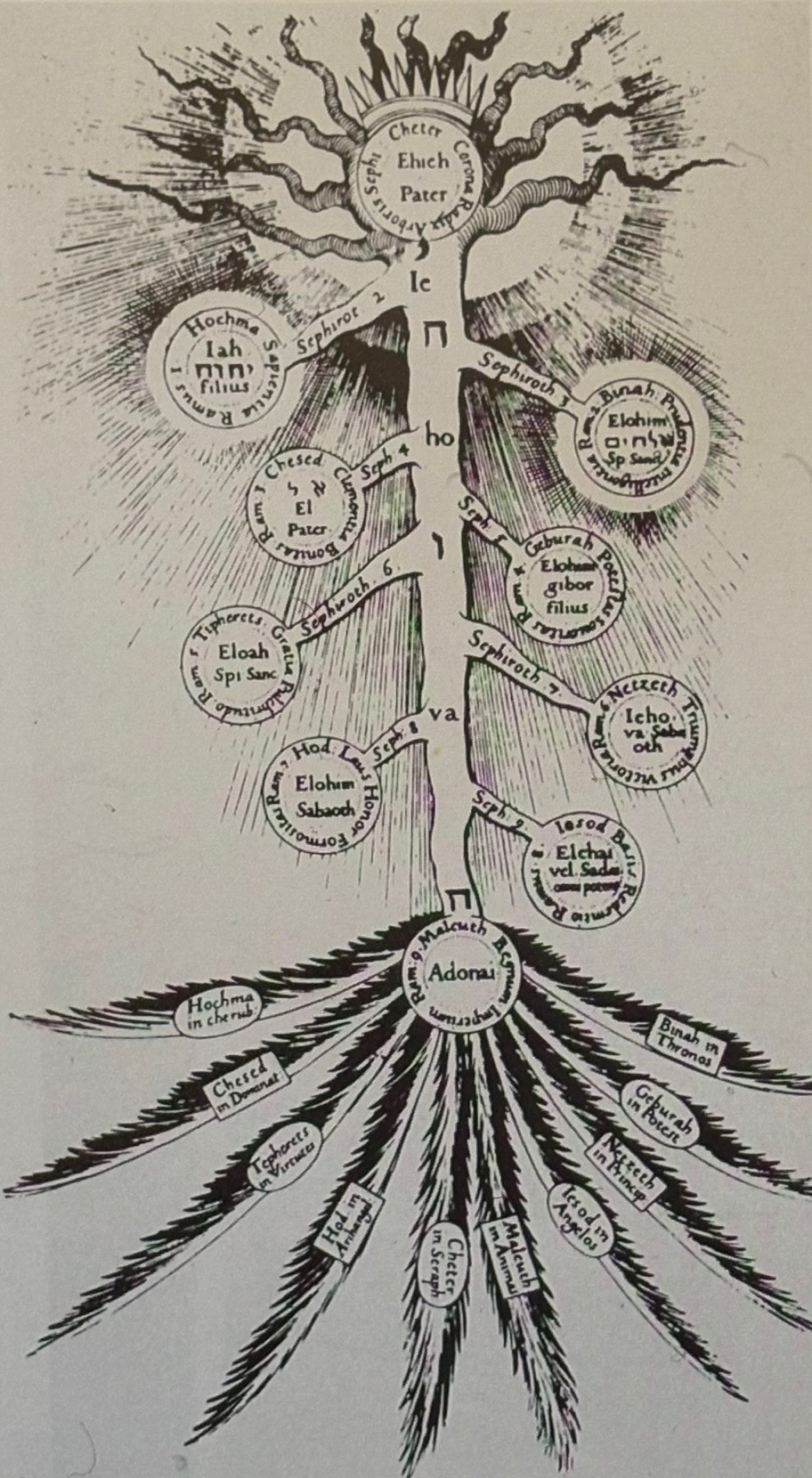
Kabbalist’s have long utilized the image of a tree to depict the growth and development as well as the organic unity of the ten Sefirot that are said to be the archetypal elements of creation and thus the basic value structure of the world. The following  “Tree of Life” (Etz Chayyim) is based upon the Kabbalah of Rabbi  Isaac Luria […]

Read More

Iggulim and Yosher: The Kabbalistic Theory of “Circles” and “Lines”

Kabbalah and the Coincidence of Opposites

The Sefirot as “Circles” In his systematic work on the Lurianic Kabbalah, Sefer Etz Chayyim. Chayyim Vital describes how previous Kabbalists have been divided on the question of the precise organization, at the time of their emanation, of the Sefirot, the ten value-archetypes through which God creates and structures the world. Some Kabbalists, Vital informs us, held that the Sefirot were […]

Read More

The Behinnot: Dialectics In The Kabbalah of Moses Cordovero

Kabbalah and the Coincidence of Opposites

Gershom Scholem, whose own interpretation of the Kabbalah was itself influenced by the philosophy of German idealism, once remarked that Moses Cordovero’s doctrine of the behinnot exemplifies the application of dialectical thinking within a Kabbalistic framework. The behinnot doctrine, in brief, states that each of the sefirot, the ten archetypes through which God emanates and structures the world, […]

Read More

Fragmentation in Contemporary Psychology: A Dialectical Solution

Kabbalah and the Coincidence of Opposites

This article was originally published in The Journal of Humanistic Psychology, Volume 43, No. 4, Fall 2003 © 2003 Sage Publications. Download PDF here Abstract: The author proposes a dialectical/realist solution to the problem of multiple paradigms in psychology.  Specifically, he argues that theoretical models in psychology are akin to various two-dimensional maps of the three-dimensional, spherical earth.  In cartography […]

Read More

J.N. Findlay: A Personal Appreciation

Kabbalistic Ideas

John Niemeyer Findlay (1903-1987) was one of the twentieth century’s most unique philosophers. At a time when positivism, scientific materialism, linguistic analysis, and ordinary language philosophy were the academic staple in Britain and America, Findlay championed phenomenology, revived Hegelianism, and wrote works that were inspired by Plotinus, Buddhism, and Absolute Idealism. In the course of a long career that brought […]

Read More

The Philosopher and the “Rav:” J.N. Findlay, Rabbi Adin Steinsaltz and the “Double Movement” in Kabbalistic Thought

Freud, Jung and Psychoanalysis | Kabbalistic Ideas

The 20th century philosopher, J.N. Findlay, in a series of little known but profound works presents a modern Neoplatonic philosophy that can help serve as a guide to a contemporary interpretation of the Kabbalah[1]. Findlay, whose Neoplatonism is enhanced by a reading of Kant and Hegel, provides a view of the deep philosophical antinomies of earthly life […]

Read More

The Lurianic Metaphors, Creativity and the Structure of Language

Kabbalistic Ideas

Download PDF here In the Lurianic Kabbalah we are witness to a theosophical account of the world’s creation, which at the same time provides a foundation for a theory of human creativity as well as a general model for understanding linguistic significance.  By explicating how the symbolic dynamic of the Lurianic Kabbalah accounts for both human […]

Read More

Ein-Sof, Nothingness and the Problem of Creation Ex Nihilo

Kabbalistic Ideas

I have been asked to comment on the notion that Ein-sof is Ayin (Nothingness) and to offer my thoughts on the problem of creation ex nihilo. In Symbols of the Kabbalah  (pp. 67-74)  I explored the Kabbalist’s equation of Ein-sof, the Infinite God, with Ayin, absolute nothingness. For example, I commented upon the 13th century Kabbalist David Ben Abraham ha-Lavan’s view that  Ein-Sof is a […]

Read More

The Torah of the Tree of Life: Kabbalistic Reflections on the Hermeneutics of Infinity in Scholem, Idel, Dan, and Tishby

Kabbalistic Ideas | Philosophical Perspectives

Introduction Contemporary scholarship on the Kabbalah has focused considerable attention on the Kabbalist’s views of language and interpretation. One reason for this, as Moshe Idel and others have observed, is that there is an important affinity between the Kabbalistic conception of infinite layers of meaning in scripture and contemporary philosophical ideas regarding the infinite interpretability […]

Read More

The Red String

Dialog

Several people have recently asked me my thoughts regarding the power of a “red string” that has been wrapped around the tomb of Rachel to ward off the evil eye.  My thoughts on this topic involve a meditation on the views of certain Kabbalists that “faith” lies at the foundation of our world (Azriel) and that the world […]

Read More

The Mystic As Philosopher: An Interview With Rabbi Adin Steinsaltz

Interviews

Interview conducted by Sanford L. Drob and Harris Tilevitz  Jewish Review: What, Rabbi Steinsaltz, is the significance of chasidus for the contemporary Jew today? Rabbi Steinsaltz: I am in a certain way terribly biased because I belong to chasidus. My background was such that chasidus was the only way that Judaism appeared, to me, in any significant way. So […]

Read More

The Doctrine of Coincidentia Oppositorum in Jewish Mysticism

Kabbalah and the Coincidence of Opposites | The Theosophical Kabbalah

(An expanded version of this article appears in S. Drob, Kabbalah and Postmodernism. These ideas are also placed in a wider context in A Rational Mystical Ascent: The Coincidence of Opposites in Kabbalistic and Hasidic Thought Introduction The doctrine of coincidentia oppositorum, the interpenetration, interdependence and unification of opposites has long been one of the defining characteristics […]

Read More

Jung’s Kabbalistic Visions

Freud, Jung and Psychoanalysis

Download full pdf Drob Kabbalistic Visions_S Drob JOURNAL OF JUNGIAN THEORY AND PRACTICE                    VOL. 7 NO. 1 2005 Jung’s Kabbalistic Visions Sanford Drob Abstract Jung’s 1944 kabbalistic visions are examined from the standpoint of Jung’s earlier provocative remarks about Jewish psychology and National Socialism, his attitude towards the Jewish sources of his own theories, and […]

Read More